

Although it often feels like it, winning poker isn’t a matter of mind reading — it’s actually a matter of hand reading.
While developing this skill set takes time, it’s worth working on. Get it right, and you could stack your chips to new heights. On the flip side, if you get it wrong, your time at the felt could amount to a steady rhythm of bad beats.
In this guide, we’re focused specifically on online poker hand reading. Since you’re not facing your opponents in person, you’ll need to use different tactics to read their hands and level up your game.
Stay Alert, Stay in the Game
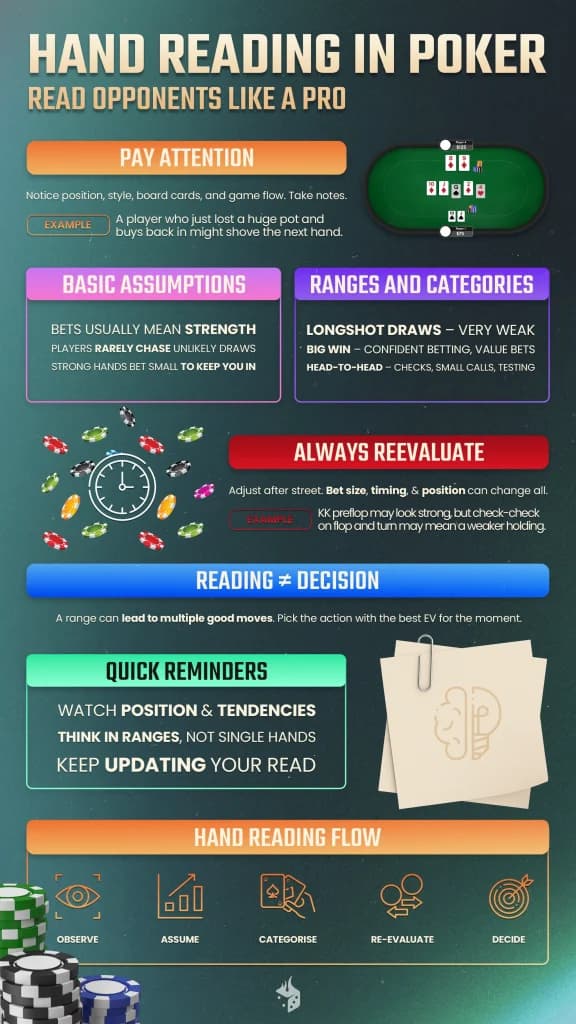
While you’re playing, keep tabs on everything: competitor positions, betting habits, the cards on the board. Everything — even a single card or wager — can shake up the overall vibe of the game.
For example, say you’re in a loose game. Players are piling their chips into multi-way pots. Supersized bets are coming from every angle. In this scenario, avoid bluffing. With ranges wide open and aggression dialled up to a 10, you’d only be running an unnecessary risk.
Here’s another hypothetical: a player has folded in each round for the last half-hour. All of a sudden, they raise you before the flop while sitting to your left. Are they trying to shake your confidence? Or do they actually have the goods?
Because they’ve been playing tight, you might suspect a premium hand — think the likes of AA, KK, or QQ. You could call that Range A. But their position and folding history open their range a bit. Maybe they’re getting antsy. Maybe they want a piece of the action, so much so that they’re willing to raise you with only a TT or a JT. This is what you’d call Range B.
At the table, every move matters. No detail is too small to guide your strategy. Keep your eyes open, your mind sharp, and be ready to strike at the right time. Like when a player who just lost a huge pot jumps right back into the action — on the hunt for a comeback, they’ll be ready to make some all-in moves.

Back to Basics: Making Assumptions
While every poker round is unique, there are some assumptions that typically hold true. As a rule of thumb, these are the assumptions you can make based on certain player behaviours to inform your hand reading:
- A bet usually means a strong hand: Sure, some players are bold enough to bluff. But in general, if an opponent places a bet, they’ve got a decent hand. Take these wagers at face value until you see more signs (if any) that they’re bluffing.
- Strong hands don’t lead to overbets: If someone has a strong hand, they don’t want to edge you out of the game straight away. They want you to place some bets and grow the pot, only for them to swoop in and claim it. With that in mind, be wary of people making sensibly sized bets; they may very well have the winning hand.
- No chasing long-shot draws: If someone has a slim chance of hitting, they’ll usually bow out early. So, don’t go assigning hands that are basically worthless according to the odds calculator. It may happen every once in a while, but don’t let those exceptions mess with your head.
Breaking Down Hand Range Categories
It can be tricky to figure out what hand ranges to put your opponents in. But it’s made easier when you break them down into these categories:
- Big-Win Hands: A big hand is bound to boost a player’s confidence. The more confident they are, the bigger moves they’ll make. When someone makes moves like this, believe them. That is, until you spy any signs of bluffing, like bullying everyone out of the pot or overbetting in late position.
- Head-to-Head Hands: With these hands, people play it safe. They aren’t looking to grow the pot, so you’ll see heaps of checks, cautious calls, and small bets designed to test the waters.
- Longshot Drawing Hands: In this context, we’re not talking semi-bluffs. We’re talking about the hands that have little to no showdown value. If you’re holding one, the only way to win the pot is to push your opponents out. But that’s no small risk — and it’s not one most players are willing to take. So, these hands tend to play out in extremes: folding without a fight or pushing aggressive bets. Very little in between.
Remember: you just need to place your competitors in a range. You don’t need to know their exact hand. Keep an open mind and be ready to change your assessment at a moment’s notice.
Reevaluate, React, Repeat
This leads us into our next tip, which is to stay agile. In poker, things can change in a second. One player could be tough as nails before the flop, but a bit more timid on the flop and turn. As their actions change, so should your interpretations of their hand. In this case, you might have originally thought they were holding a KK or a QQ due to their initial boldness. But as they tightened their range, you might suspect a TT or a KQ.
Throughout the game, ask yourself a few questions to reassess your opponents. How long are they taking to make decisions? What size bets are they making? What position are they in? Don’t let someone sell you an image early and lock it in for the entire hand. Keep adjusting your read as new information comes in, and make your calls as they come.

Good Reads ≠ Good Plays
It’s important to have an idea of what your opponents are holding. But here’s the catch: knowledge doesn’t equal strategy. Even if your hand reading is on point and you know exactly what cards they’ve got, it doesn’t mean you’ll know what to do next.
Oftentimes, you’ll have the option to call, fold, or raise — and each move could be justified. That’s why you need to create a flexible strategy, agile enough to handle that kind of uncertainty. You’re not going to make the right call 100% of the time, but that’s part of poker’s appeal: it keeps us on our toes.
But at the very least, you should be able to justify your choices. You should be able to not only make decisions but also explain why you made those decisions. If you can’t, it’s a sign to take a closer look at your strategy. With some reflection and adjustment, you’ll sharpen your instincts and become a more confident hand reader.