

If you’re new to the world of poker, the game may seem complicated, confusing, and intimidating. But learning how to play poker is often easier than newcomers expect.
The best place to start learning how to play poker is studying the rules of Texas Hold’em. As the most popular type of poker in the world, it’s a common entry point for beginners. Once you know how to play Texas Hold’em, other types of poker — such as Omaha — will be simpler to learn, too.
Texas Hold’em Glossary
When learning how to play poker, understanding the terminology is crucial. The game’s key terms typically refer to betting actions or card types.
- Pot: The chips placed on the table and the money paid to the winner(s).
- Hole cards: The two cards dealt to each player at the start of a game.
- Hand: A player’s best combination of five cards and the full poker game.
- Community cards: A set of five cards placed in the middle of the table during a game. Players use community cards to build their hand.
- Bet: The money that players place into the pot at four points in a game.
- Bluff: A misleading raise or bet that one player makes to throw others off.
- Fold: A player discards their hand and exits the current game.
- Raise: Increase the bet placed by another player.
- Call: Match the bet placed by another player.
- Check: A player decides not to bet but remains in the game.
Don’t worry about trying to memorise all of these terms from the start. Simply refer back to the glossary as you play to better absorb them.
What is Your Goal in Texas Hold’em?
In Texas Hold’em, your goal is simple: win the pot. You can do that in one of two ways:
- Create the strongest five-card hand: Use your two hole cards and three community cards in any recognised combination.
- Bluff your way to the win: Force every other player to fold by convincing them you have the best hand.

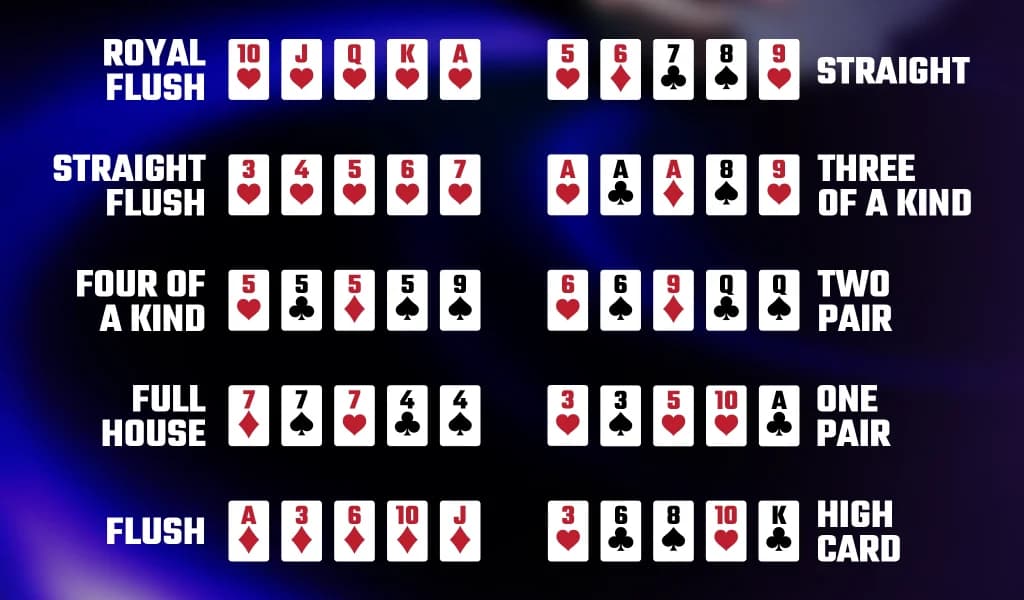
To recognise which cards form the strongest hands, you need to understand Texas Hold’em poker hand rankings. The strongest is a Royal Flush (e.g. A♠ K♠ Q♠ J♠ 10♠), while the weakest is a high card (a single highest-value card).
Forcing other players to fold is tough, especially for beginners. Seasoned poker players often raise to make opponents doubt their hand strength. If other players believe your hand is too good to beat, they’re likely to fold.
However, confident opponents who assume you’re bluffing may also play aggressively to stay in the game. Avoid trying to force other players into folding until you’re comfortable with the mechanics of the game.
How Many Cards are Used in Texas Hold’em?
Texas Hold’em is played with a standard deck of 52 playing cards (minus the jokers).
There are four suits in a deck:
- Spades (♠)
- Diamonds (♦)
- Clubs (♣)
- Hearts (♥)
Each suit has 13 cards, ranging from 2 to Ace.
Any of these cards may be dealt randomly as hole cards (i.e. the cards you hold in your hand) or community cards (i.e. the cards laid face-up on the table). The dealer must shuffle the cards before each hand to ensure they’re randomly distributed.
How Many Betting Rounds are in a Texas Hold’em Game?
A hand of Texas Hold’em includes four betting rounds. While every round is formatted similarly, you’ll need to use distinct strategies depending on the cards you see, the cards you hold, and the behaviours of your competitors.
1. Pre-Flop
The dealer gives each player two face-down hole cards. Players must keep their hole cards private.
The player seated to the dealer’s left posts the ‘small blind’ to start the pre-flop stage. In Texas Hold’em, blinds fund the pot and prevent players from waiting idly for strong cards to come along.
The small blind is determined by the bet limits agreed before the game starts. It’s usually half of the ‘big blind’, which is paid by the player next to the small-blind position. The big blind is typically equal to the minimum bet, according to the table limits.
Once the small blind is posted, betting moves around the table in a clockwise direction. The dealer to the left of the big blind makes the first bet. Every player has the option to call, raise, or fold.
The second stage begins after all players have taken action.

2. The Flop
The ‘flop’ refers to placing the first three of five community cards on the table. Community cards are always face up.
Players compare their hole cards to the community cards to work out the hands they could make. The better you know how to play poker, the faster you’ll see possible card combinations.
Another round of betting begins. If no players bet, you can check to avoid wagering without leaving the hand.
3. The Turn
The dealer adds the fourth community card (known as the ‘turn’) to the table. At this point, players should have a good idea of the hand they can make.
The third betting round starts once the community card is in position.
4. The River
The dealer places the fifth community card (the ‘river’) on the table. Players can now see all of the seven cards available to build their hand.
The last betting round plays like the rest.
After the River: The Showdown
Any players left in the game after the river must show their hole cards to reveal their final hand.
If you have the best hand or all of your opponents fold after the river, you’ll win the pot.
What is the Best Hand in Texas Hold’em?
A Royal Flush is the best possible hand in Texas Hold’Em. There are 10 hands in Texas Hold’em:
- Royal Flush: A 10, Jack, Queen, King, and Ace of the same suit.
- Straight Flush: A same-suit set of five cards of consecutive rank (e.g. 3♥ 4♥ 5♥ 6♥ 7♥).
- Four of a Kind: Four cards of identical rank and one other card, known as the kicker (e.g. 5♦ 5♥ 5♠ 5♣ 9♠).
- Full House: Three cards of the same rank and two of another (e.g. 7♦ 7♥ 7♠ 4♣ 4♠).
- Flush: Five cards of the same suit in any order (e.g. A♦ 3♦ 6♦ 10♦ J♦).
- Straight: Five cards of consecutive rank and mixed suits (e.g. 5♥ 6♦ 7♣ 8♠ 9♥).
- Three of a Kind: Three cards of identical rank and two other cards (e.g. A♦ A♥ A♣ 8♠ 2♦).
- Two Pair: Two pairs and one other card (e.g. 6♠ 6♥ Q♠ Q♣ 9♦).
- One Pair: Two cards of identical rank and three cards of any suit or rank (e.g. 3♥ 3♠ 5♥ 10♥ A♣).
- High Card: The top-ranking card in your hand. The high card is helpful when no players can create a known hand or two players have the same hand.
In Texas Hold’Em and many other poker variants, suits are not ranked. The only time the suit of your cards matters is in determining if you have any type of Flush. For example, a Royal Flush of Hearts is equal rank to a Royal Flush of Spades.
What are Poker Odds?
Poker odds refer to the probability of an outcome, usually winning a hand.
Calculating odds is a major part of knowing how to play poker. You can use odds to understand whether calling or raising is likely to benefit you.
Poker has three types of odds:
- Pot odds: Help you calculate whether the possible reward of calling is worth the risk of a loss. They compare the pot’s size to the size of a call.
- Implied odds: The amount you could win if you stay in the game and build a strong hand.
- Reverse implied odds: The loss you face if you reach the showdown but get defeated.
‘Outs’ are also important, as they’re related to poker odds. Outs are the cards still in the deck that will give you a winning hand if they’re dealt to you. Calculating outs can help you understand your probability of winning and inform your decision to call or fold.
Comfortably calculating poker odds takes time and practice, but it can make you a more strategic player.
Texas Hold’em vs Omaha Poker
Omaha is one of the other top poker variants. It’s similar to Texas Hold’em in most ways, but with two key differences:
- Each player gets four hole cards instead of two, and
- You must use two hole cards and three community cards to build your hand.
Having extra hole cards gives you more possible hand combinations. You and your opponents may create strong hands sooner than in Texas Hold’em. Omaha gameplay is often faster and more intense, and the pots are generally bigger.
Omaha also has its own sub-variant, Omaha Hi-Lo. The game works the same as the original, except there are two pots up for grabs instead of one. Players can win the ‘high pot’ by forming the highest five-card poker hand. Or, they can win the ‘low pot’ by creating the best qualifying low five-card poker hand. For a hand to qualify for the low pot, all cards must have a ranking of 8 or lower.
Playing Poker Online vs Playing at a Casino
Now more than ever, playing poker is more convenient and accessible for newcomers. While brick-and-mortar casinos may feel daunting, online casinos like Ignition Casino offer a safe space for beginners. Here, nobody can watch your reactions or read your body language — you can simply practice and hone your skills in peace.
Ready to try Texas Hold’em, Omaha Poker, and other poker variants online?