

Knowing how to calculate poker odds is crucial to mastering the game and helping players avoid frustrating losses. While calculating poker odds can seem intimidating at first glance, with a bit of practice, it’ll be second-nature.
Familiarising yourself with the basics helps optimise your play, in turn making it so you don’t have to rely on luck of the draw as much.
In this guide, you’ll learn about counting poker outs, calculating implied odds, and everything in between. Plus, you’ll find easy-to-follow formulas to help you calculate both, letting you build better hands, develop your poker strategy, and, in turn, score more wins.
What Are Outs in Poker?
Poker outs refers to any card that could help you create a stronger hand. Counting outs helps you calculate your chances of winning or losing, playing a key role in overall poker probability.
By counting outs, you can decide whether it’s worth staying in the game or folding. Before you start counting poker outs, make sure you’re familiar with the different poker hand rankings to ensure you know what cards you need to win.
How to Count Poker Outs
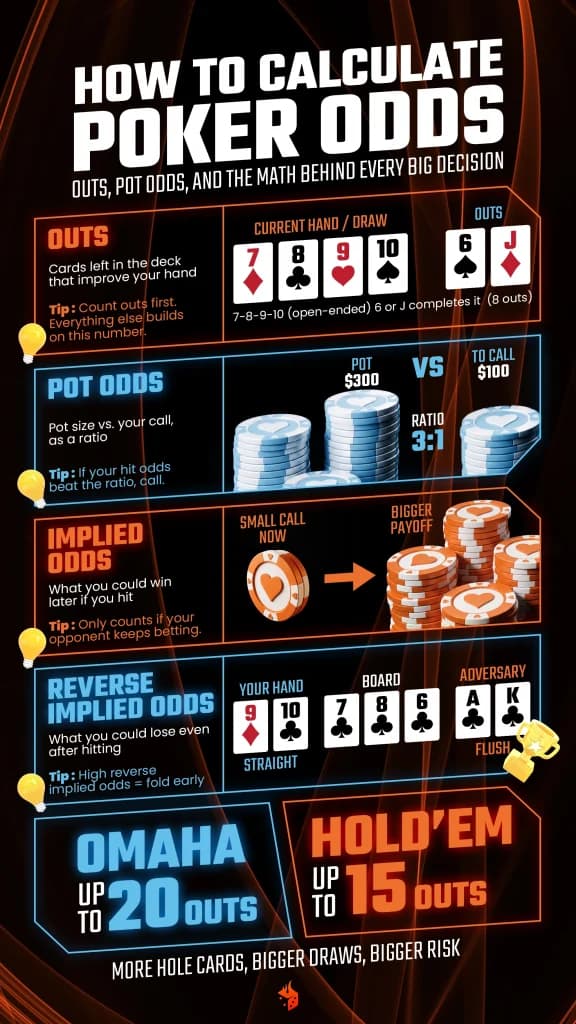
In order to count poker outs, you need to assess your hole cards alongside the community cards. As an example, say you receive 9♦ and 10♣ as hole cards. If the flop brings 7♠ and 8♥, you now hold four consecutive cards: 7-8-9-10.
This is an open-ended straight draw, which means two different ranks complete it (either a 6 or jack of any suit). Because there are four 6s and four jacks remaining in the deck, you therefore have eight outs.
If you factor in pairs/quads for your 9♦ and 10♣, then you have a further six outs for a total of 14 outs. This doesn’t factor in other potential hands, such as a full house or flush, which will change the total number of outs.
For quick reference, you can memorize the outs for common draws in poker:
| Draw | Number of Outs |
| Open-ended straight flush draw + 2 overcards | 21 |
| Open-ended straight flush draw + 1 overcard | 18 |
| Open-ended straight flush draw | 15 |
| Gutshot straight flush draw | 12 |
| Flush draw + 2 overcards | 15 |
| Flush draw + 1 overcard | 12 |
| Flush draw | 9 |
| Open-ended straight draw + 2 overcards | 14 |
| Open-ended straight draw + 1 overcard | 11 |
| Open-ended straight draw | 8 |
| Set to full house/quads | 7 |
| Two pair to full house | 4 |
| 2 overcards | 6 |
| 1 overcard | 3 |
| Pocket pair to set | 2 |
The Importance of Counting Poker Outs
Outs are directly linked to your odds of improving your hand. In turn, they play a key role in your decision-making on the felt (i.e., whether to call, raise, or fold).
For instance, you might be debating whether to match an aggressive bet laid down by an opponent. If your outs are on the lower side, it means your chances of bettering your hand are lower. With that in mind, it may be wiser to fold to avoid further losses.
What Are Pot Odds?
Pot odds are another important element of poker probability, and represent a very important ratio: the size of the total pot compared to the size of a call bet you’re considering. Pot odds exist to help convey the relationship between risk and reward, in turn helping you make smarter betting decisions.
Or to put it in another way, pot odds are a type of cost-benefit analysis, examining how much you stand to gain versus how much you stand to lose.
The Importance of Calculating Pot Odds
Like counting your outs, learning how to read pot odds quickly is vital to ensure you’re making informed, strategic decisions. Specifically, knowing your odds makes it easy to determine whether or not you should call a bet placed by your opponent. Rather than trusting your gut, you can rely on the pot odds to guide your calls, raises, and folds.

How to Read Pot Odds
Calculating pot odds is a simple three-step process:
- Determine the final pot size: This is how much the pot would be if you called. For example, say you’re playing heads-up poker, with the pot total sitting at $100. Your opponent wagers $50. That means the total pot size (if you called) would be $200.
- Establish the ratio: Compare the size of the pot to the size of the call in ratio format. In this case, that would be 200:50, which then equates to a simplified ratio of 4:1.
- Convert it to a percentage: While this is optional, it can help in better understanding your odds. To convert your ratio into a percentage, divide the second figure by the first (i.e., 1/4 = 0.25, which equates to 25%). This means you need to have the strongest hand at least 25% of the time to make the call profitable. This is also referred to as “equity.”
The Rule of 4 and 2
When it comes to learning how to read pot odds, the Rule of 4 and 2 is an extremely simple but helpful rule. It allows you to quickly translate the number of outs into your odds of winning at different stages of a poker game.
Here’s an example of how it works using the previous example (A-10 of spades as your hole cards) of 11 outs for a flush:
- Pre-flop: 11 outs
- The flop: The flop shows one additional spade card, meaning you now have 10 outs.
- Multiply by 4: To calculate your approximate odds of getting a winning card on the turn or the river, multiply the number of outs by 4 (i.e., 4 x 10 = 40, so you have a 40% chance).
- The turn: The turn shows another spade card, meaning you now have 9 outs.
- Multiply by 2: To calculate your approximate odds of getting a winning card on the river, multiply the number of outs by 2 (i.e., 2 x 9 = 18, so you have an 18% chance).
Poker Odds FAQ
Calculating poker odds removes the need to guess your way through games and rely purely on gut instinct. It empowers you to make informed decisions about calling, raising, and folding.
Poker outs are any unseen cards still in the deck with the potential to turn your hand into a winner. If you have four spades and want to make a flush, you have nine outs (as there are nine spades left in the deck).
Odds are different in Omaha and Texas Hold’em because the games are set up differently. Omaha players receive four hole cards. They must use two of them in combination with three community cards to build a five-card hand. In contrast, Texas Hold’em players receive two hole cards and can use any combination to build a five-card hand.
Yes. Understanding how to calculate poker odds matters against bluffing players, as you can use implied odds to make strategic decisions. Bluffers won’t bank on you to call in many cases, and using implied odds can help you beat their strategy.
Putting it All Together: Know When to Call (And When To Fold ‘Em)
Now you know how to calculate your pot odds. Great! But what does that figure actually tell you? How do you know when to call and when to fold?
Remember everything you learned about outs. It’s time to put it all together, and it starts by calculating how often you’ll hit your draw. This means weighing your outs against cards in the deck that can’t help you improve your hand.
The hard part here is estimating what your opponents have. Every card not in your hand or in the river could be a card in their hand, which represents their range. Calculating their range takes a bunch of mental math, so in general, it’s best to try and remember some common pre- and post-flop ranges. You can find some handy charts for most of this information to use as a training aid to build your skills.
But if you take one thing away from all this information, let it be this: if your pot odds don’t meet or beat that figure, it’s not worth calling.