To an outsider, poker can look like a game of chance where luck of the draw dictates who goes home a winner, with “poker skills” feeling like some made-up thing. But anyone who’s spent enough time on the felt knows better.
At its core, poker is the ultimate test of decision-making. It forces you to make big calls with limited information. While you rarely have all the facts, you need to make sound choices to the best of your ability, just like in real life.
Whether you’re navigating a tricky negotiation or deciding on a major career move, the habits you form at the table can bleed into your everyday routine and influence your decisions for the better.
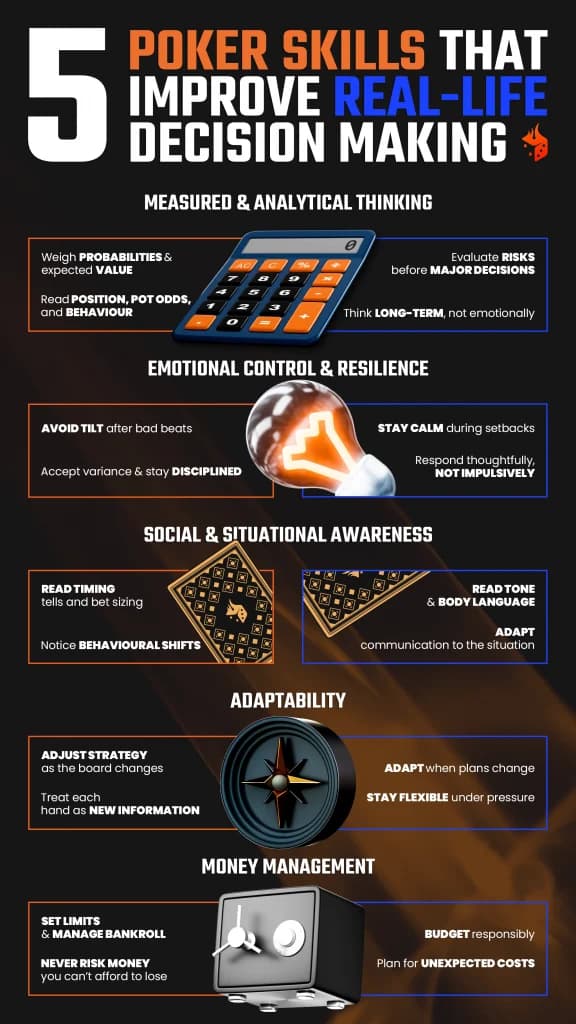
Here are five essential poker skills that are sure to sharpen your instincts in the real world.
1. Measured & Analytical Thinking
One of the things poker breeds out of you is the habit of making “gut-feel” calls.
In poker, acting on a whim is a surefire way to dwindle your stack. To avoid this, you’re forced to develop an analytical mindset. You learn to weigh up probabilities and assess the expected value (EV) of every move. You learn to look at your position, the pot odds, and opponent behaviours before you even think about sliding your chips into the middle.
This mindset is a game-changer for big life decisions. Maybe you’re thinking about leaving a stable job to start your own business. Or maybe you’re considering a major investment like a house. Instead of reacting to outside pressures or chasing instant gratification, a poker-trained mind looks at the big picture and reframes life’s major crossroads as a series of calculated risks rather than blind gambles.
2. Emotional Control & Resilience
If you want to survive more than 10 minutes in a game of Texas Hold’em, you need to get a grip on your emotions. Specifically, you have to avoid tilt. Tilt is the state of frustration that bubbles up after a bad beat, often prompting you to play recklessly to get your money (or pride) back. When you play poker, you learn quickly that letting your emotions rule can result in even bigger losses.
The game also introduces you to the reality of variance, which are natural ups and downs that every player faces. Although they can be tough to swallow, the downswings — short-term runs of losses — are valuable for building resilience. The more resilient you are, the better you’ll be at sticking to your strategy, even when things aren’t going your way.
In your day-to-day life, this emotional regulation and resilience are worth their weight in gold. Whether you’re going through a disagreement with your partner or you’ve had a bad day at the office, these poker skills help you pause and regain your composure. Instead of reacting impulsively, you learn to respond thoughtfully.
3. Social & Situational Awareness
Poker is played against people, not cards. Since you can’t see what’s in another player’s hand, you have to become a human lie detector. You learn to pick up on tells: a tiny shift in timing, a sudden switch-up in bet sizing, or a subtle change of posture. During every round, you’re looking for the real story behind the facade.
This translates into better communication and stronger intuition in the real world; that awareness of tone and body language will empower you to read any room you’re in.
Even more importantly, you can then use those insights to adjust your behaviour, just like you would on the felt. In poker, you might notice a competitor fidgeting nervously and decide to raise. In the workplace, you might see a colleague furrow their brow as you’re giving a presentation. You could use that real-world cue to change your approach, such as pausing to provide extra clarification on a topic that may have been confusing.
4. Adaptability
In a game of poker, one card can change everything. As a result, the strategy that worked five minutes ago could be useless now. That’s why sticking to a single strategy is a one-way ticket to going bust. To stay alive and in the game, you need to be able to pivot.
The same rule applies in life. Without a doubt, you’re going to be thrown a few curveballs: shifting deadlines, parking fines, delayed flights — the list goes on. Poker teaches you to reassess these situations and adjust your plans without hitting the panic button.
By playing enough poker, you’ll turn yourself into an adaptable thinker who doesn’t resist change but leans into it. Instead of getting flustered when things go wrong, you’ll learn to treat these new situations as a fresh “hand” to be played.
5. Money Management
This is one of the most practical poker skills for every player to master. Bankroll management is the art of setting responsible limits (aka stop losses) and handling risk.
The key to effective bankroll management is discipline. You need to know when to walk away and to never put so much on the line that one bad beat could destroy your bottom line.
These habits are a perfect mirror for responsible money management in the real world. Budgeting, planning for unexpected costs, and avoiding unnecessary spending are all built on the same foundation of willpower.
Poker teaches you that even the best players can go broke if they ignore their limits and start gaming with money they need for crucial expenses, such as rent or groceries.
Making Smarter Decisions On and Off the Felt
The poker skills you learn at the table go far beyond the game itself. They’re the building blocks of a sharper mind — one that’s analytical, resilient, and responsible.
From keeping your cool in a crisis to managing your hard-earned cash, the habits you pick up will help you make smarter decisions long after the final hand is dealt.